AI assistant
An AI assistant that knows your portfolio
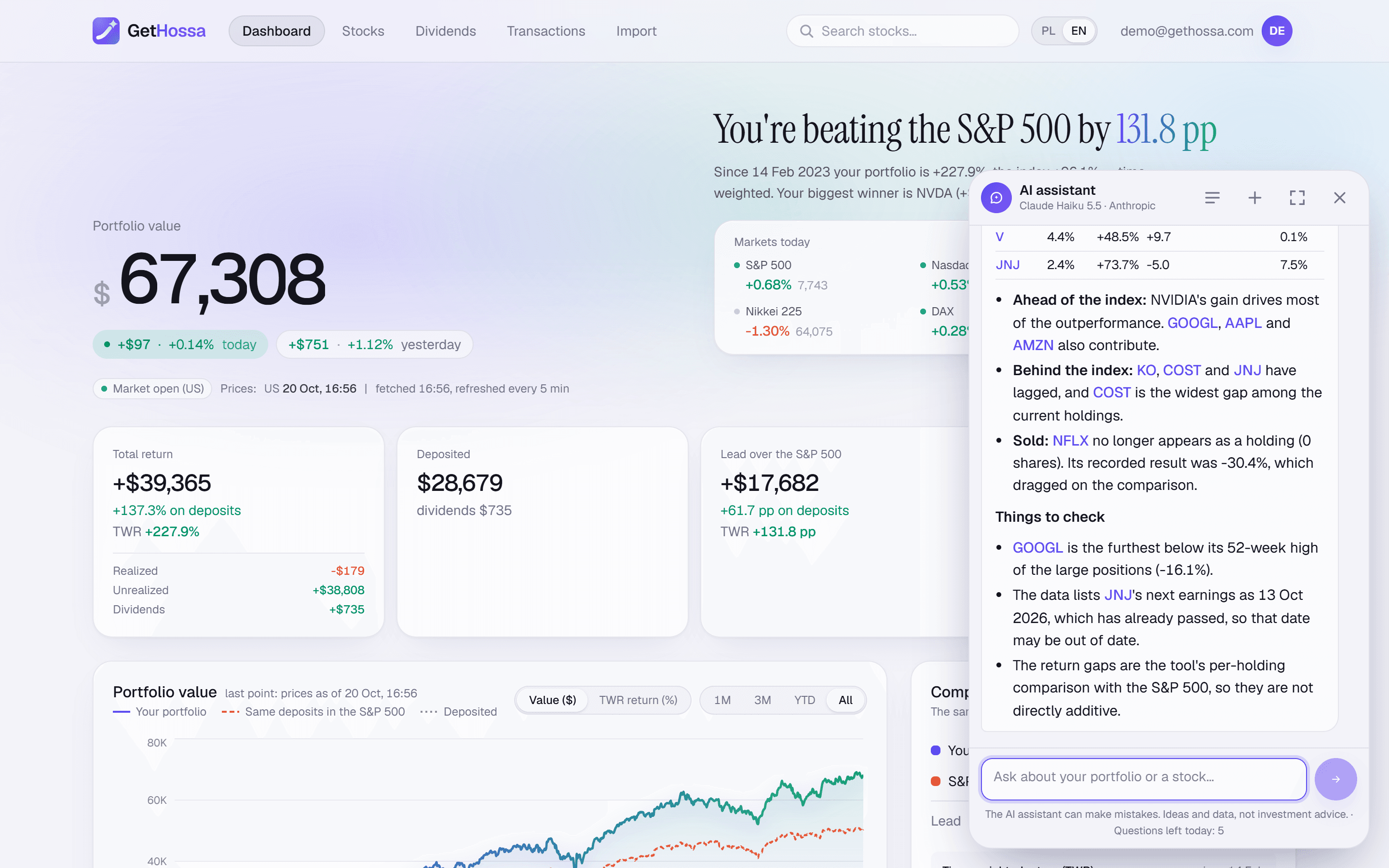
GetHossa's assistant runs on Claude Haiku, a model by Anthropic. Before it answers, it pulls your holdings, company fundamentals, price history and recent filings, so you talk about your actual positions instead of generic market commentary.
Uses your real numbers
It looks up your holdings, weights, results and S&P 500 comparison before answering a question about your portfolio.
Knows the page you're on
Open it on Apple's company page and “this company” means Apple. One click on “AI summary” starts a briefing.
Ideas, not orders
It lays out arguments and risks and suggests companies worth researching. It won't tell you to buy or sell.
What it does
Once you sign in, a chat button sits in the corner of every screen. Ask a question in plain English and the assistant answers using the same data GetHossa shows you, fetched at the moment you ask. It runs on Claude Haiku, a model made by Anthropic.
Typical questions it handles well:
- "Summarize my portfolio against the S&P 500."
- "Which of my stocks are furthest below their highs?"
- "Is NVDA expensive compared with its own P/E history?"
- "How did the stock react to the last four earnings releases?"
- "What are the main risks for Costco right now?"
- "Suggest quality US companies trading well below their highs that I could research."
Every ticker in an answer becomes a link to that company's page in GetHossa, so you can check the numbers yourself.
How it works
The assistant doesn't rely on memory for anything current. It has a set of tools and decides which ones a question needs:
- Your portfolio: total value, money invested, total return, time-weighted return, today's change, the S&P 500 comparison, and every holding with its weight, average price, result, distance from its 52-week high and next earnings date.
- Company fundamentals: business description, valuation multiples with the 5-year P/E range, margins, growth, debt, annual results, analyst price targets and earnings surprises.
- Price statistics: returns from 1 month to 5 years, distance from the 52-week and all-time highs, 50- and 200-day averages, and how the price moved after each results release.
- News and SEC filings: recent headlines (mostly for US companies) and the latest 8-K announcements, 10-Q and 10-K reports, with links.
- Web search: when the app's data isn't enough, for example why a stock moved today, it can search the web a few times and name its sources.
It also sees the page you have open, your portfolio currency and today's date. On a company page, an AI summary button asks for a short briefing: what the company does, how results are trending, whether the valuation is high against its history, recent filings, and the main opportunities and risks.
Who it's for
- Investors who want a second look at their positions without opening ten browser tabs.
- People who are researching a new company and want the key numbers gathered in one place before reading the 10-K.
- Anyone who prefers asking "why is this down 8% this week?" to scrolling through headlines.
Details
- Conversation history is saved in your account. You can rename or delete any conversation, and start a new one at any time. Very long conversations eventually need to continue in a new thread.
- Language: it replies in the language of your question, English or Polish.
- Fair use: each account has a daily question allowance, which resets the next day.
- Data sources: prices and fundamentals come from Yahoo Finance, filings from SEC EDGAR. How GetHossa calculates returns and comparisons is described on the methodology page.
Honest limits
- It can be wrong. Language models sometimes misread data or state things with more confidence than they deserve. Check important figures on the company page or in the filing itself.
- Headlines, not full texts. For news and SEC filings it sees titles and filing types, not the documents, and it says so when that matters.
- Coverage is uneven. News and filings are strongest for US companies; for smaller foreign listings, data can be thin.
- Not investment advice. It gives information, context and ideas to research. It won't tell you what to buy, sell or hold, suggest position sizes or promise returns; the decision stays with you.
Create an account, add your trades and ask your first question.
Frequently asked questions
Which AI model does GetHossa use?+
Claude Haiku, a model by Anthropic. It's combined with GetHossa's own tools, so answers about your portfolio and companies come from current data rather than from the model's training knowledge.
Can the assistant see my brokerage account?+
No. GetHossa never connects to your brokerage. The assistant sees only what's in GetHossa: the trades you imported or entered, your watchlist, and market data. It can't place orders.
Will it tell me which stocks to buy?+
No. It can suggest companies worth researching, with the arguments for and against and the main risks, but it doesn't give personalised buy, sell or hold recommendations.
Is there a limit on how many questions I can ask?+
Yes, there's a daily question allowance per account. It resets the next day, and your earlier conversations remain available in the meantime.
Try it on your own portfolio
The account is free. Import your history or add trades by hand — you'll see the result right away.
Create account